

Overcoming User Research Challenges in UI/UX Design
In a world where users decide within seconds whether they like a product or abandon it, UI/UX design has become less about decoration and more about survival. Every tap, scroll, and click is a test—and users don’t forgive confusion. This is why understanding what people actually think and do inside a product has become the real power behind great digital experiences.
But here’s the catch: users rarely say what they truly mean, and what they do is often very different from what they claim. That gap makes user research both incredibly valuable and surprisingly tricky. Designers are constantly trying to decode real behavior from incomplete feedback, limited data, and unpredictable human decisions.
This article breaks down those challenges and explores practical ways to handle them, so user research doesn’t just become a checkbox in the process—but a real advantage in building better products.
The Importance of User Research in UI/UX Design
User research is the foundation of effective UI/UX design because it shifts the design process from assumptions to evidence-based decisions. Instead of guessing what users might want, designers gather real insights about user behavior, motivations, and challenges. This helps in building products that are not only visually appealing but also intuitive, accessible, and aligned with real-world usage patterns. When user research is done properly, it significantly reduces the risk of redesigns, improves usability, and increases overall user satisfaction.
Beyond improving usability, user research also plays a major role in business success. It helps teams prioritize features that truly matter to users, eliminate unnecessary complexity, and create smoother user journeys. This leads to higher engagement, better retention, and stronger conversion rates. In a competitive digital landscape, products that deeply understand their users gain a clear advantage over those built on assumptions.
Common Challenges in User Research

-
Limited Budget
Budget constraints are a common hurdle in user research. Many organizations, especially startups, may not allocate sufficient funds for comprehensive research. This can limit the scope of research activities and the number of participants involved.
-
Time Constraints
Time limitations often pressure design teams to shorten or skip user research phases. This can lead to incomplete data and insights, ultimately affecting the quality of the final design.
-
Recruiting Participants
Finding the right participants for user research can be challenging. Participants need to match the target user persona to provide relevant insights. Recruiting these individuals can be time-consuming and expensive.
-
Balancing Quantitative and Qualitative Data
Quantitative data provides measurable insights, while qualitative data offers deeper understanding of user behaviors and motivations. Balancing these two types of data can be challenging but is essential for a comprehensive understanding of user needs.
-
Bias in User Research
Bias can creep into user research at various stages, from participant selection to data analysis. This can skew results and lead to inaccurate conclusions.
-
Keeping Up with UI UX design Trends
The digital landscape is constantly evolving, with new technologies and trends emerging regularly. Staying updated with these changes and understanding how they affect user behavior can be difficult.
-
Communicating Findings
Presenting research findings in a way that is understandable and actionable for stakeholders can be challenging. Effective communication is crucial for ensuring that research insights are implemented correctly.
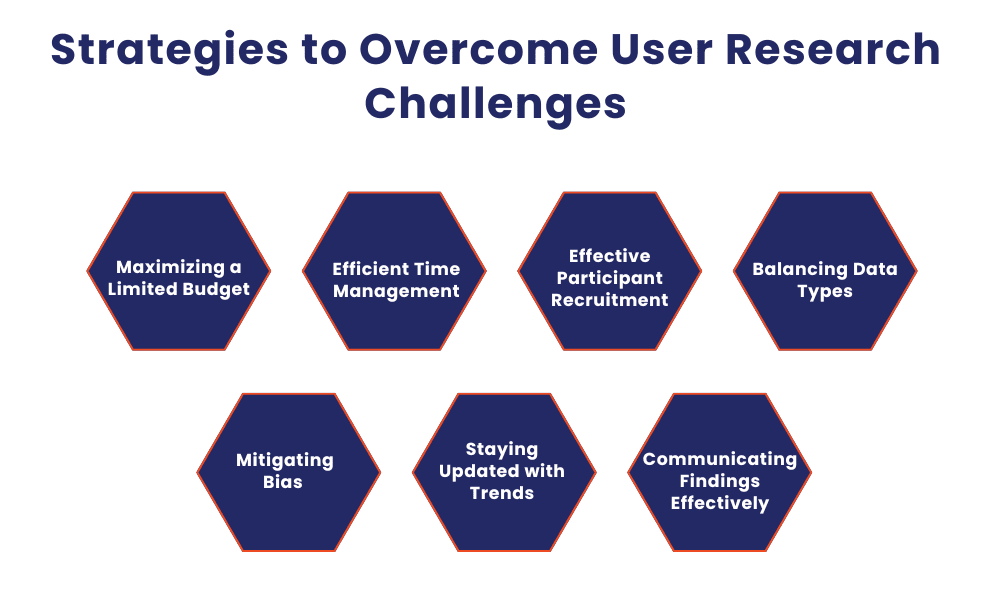
Strategies to Overcome User Research Challenges
-
Maximizing a Limited Budget
To make the most of a limited budget, prioritize essential research activities that will have the most impact. Utilize cost-effective methods such as online surveys, remote usability testing, and leveraging existing data.
-
Efficient Time Management
Integrate user research into the design process from the beginning to avoid last-minute rushes. Use agile methodologies to conduct iterative research and design cycles, ensuring that you gather insights continuously without delaying the project.
-
Effective Participant Recruitment
Use multiple channels to recruit participants, such as social media, professional networks, and user panels. Offering incentives can also attract more participants. Additionally, consider using remote research tools to widen your pool of potential participants.
-
Balancing Data Types
Employ mixed methods research to balance quantitative and qualitative data. Start with quantitative methods like surveys to gather broad insights, then use qualitative methods such as interviews and focus groups to dive deeper into specific areas.
-
Mitigating Bias
To reduce bias, ensure that your research methods and participant selection processes are as neutral as possible. Use random sampling techniques and validate your findings with multiple data sources. Training researchers to recognize and mitigate their own biases is also crucial.
-
Staying Updated with Trends
Regularly engage with industry publications, attend webinars, and participate in professional communities to stay updated with the latest trends. Continuous learning and adapting to new tools and methodologies will help you stay ahead in the dynamic field of UI/UX design.
-
Communicating Findings Effectively
Create clear, concise, and visually engaging reports and presentations to communicate research findings. Use storytelling techniques to make the data more relatable and actionable for stakeholders. Tools like infographics and user journey maps can help visualize complex data.
Tools and Techniques for Effective User Research

-
Surveys and Questionnaires
Surveys are a cost-effective way to gather quantitative data from a large audience. Tools like Google Forms, SurveyMonkey, and Typeform make it easy to create and distribute surveys.
-
Usability Testing
Usability testing involves observing users as they interact with your product. This can be done in person or remotely using tools like UserTesting and Lookback. It provides valuable insights into user behaviors and pain points.
-
User Interviews
Conducting one-on-one interviews allows for deep exploration of user needs, behaviors, and motivations. Interviews can be structured, semi-structured, or unstructured depending on the research goals.
-
Focus Groups
Focus groups involve guided discussions with a group of users. This method is useful for generating ideas and understanding user attitudes and perceptions.
-
Analytics Tools
Tools like Google Analytics, Hotjar, and Crazy Egg provide quantitative data on how users interact with your product. This data can reveal patterns and areas for improvement.
-
Card Sorting
Card sorting helps understand how users categorize information. This technique can inform the information architecture of your product, ensuring that it aligns with user expectations.
-
A/B Testing
A/B testing involves comparing two versions of a design to see which performs better. This method is effective for making data-driven decisions and optimizing user experience.
The Role of Empathy in User Research

Empathy is one of the most important foundations of effective user research because it allows designers to step outside their own assumptions and truly understand the people they are designing for. Instead of focusing only on features or visual design, empathy helps uncover what users feel during their journey—whether they are confused, frustrated, confident, or satisfied. These emotional insights often reveal problems that data alone cannot explain, making empathy a powerful tool for creating meaningful and user-centered experiences.
When designers genuinely understand user emotions and pain points, they are able to design solutions that feel more natural and intuitive. For example, a user struggling to complete a checkout process is not just facing a technical issue—they may be feeling stress, impatience, or even distrust. Recognizing these emotional layers helps designers simplify flows, reduce friction, and create experiences that feel supportive rather than overwhelming.
One of the most effective ways to build empathy in user research is through persona development. Personas are detailed, research-based profiles that represent key user groups, including their goals, behaviors, motivations, and frustrations. By referring to these personas throughout the design process, teams can make more consistent and user-focused decisions. Instead of designing for “everyone,” personas help designers design for real, specific people—making the final product far more relevant and impactful.
Integrating User Research into the Design Process
Integrating user research into the design process means treating it as a continuous loop rather than a one-time step. Instead of conducting research only at the beginning of a project, designers should collect insights at every stage—from ideation and wireframing to prototyping, testing, and even after launch. This ensures that design decisions are always grounded in real user behavior rather than assumptions.
When user feedback is consistently included throughout the development cycle, it becomes easier to identify problems early and make improvements before they become costly. For example, early testing can reveal usability issues in navigation, while post-launch feedback can highlight real-world usage patterns that were not initially expected. This iterative approach helps teams refine the product gradually, ensuring it evolves alongside user needs.
Ultimately, integrating user research into every stage creates a more responsive and user-centered design process. It allows teams to build products that are not only functional at launch but also continuously improved over time, resulting in better usability, stronger engagement, and higher user satisfaction.
UX Design Principles: Crafting User-Centric Experiences for Your App
Conclusion
Overcoming user research challenges in UI/UX design is not about eliminating obstacles completely, but about handling them with the right strategy, mindset, and tools. Issues like limited budgets, tight deadlines, difficulty in finding the right participants, and bias in data collection are common in most design projects. However, when these challenges are approached systematically, they can be transformed into opportunities to gain deeper and more meaningful user insights.
A strong user research process relies on consistency, flexibility, and clear communication. Designers who balance qualitative and quantitative data, stay updated with evolving UX trends, and actively validate their assumptions are more likely to create designs that truly resonate with users. Equally important is the ability to communicate research findings in a clear and actionable way, so that the entire team can align their decisions around real user needs.
Ultimately, successful UI/UX design is driven by empathy and continuous learning. When user research is integrated throughout the design lifecycle—not just treated as a one-time step—it leads to more refined, intuitive, and impactful digital experiences. By combining strategic research methods with a user-first mindset, designers can consistently deliver products that are both effective and meaningful.
At Techqee, we focus on turning these research insights into practical, user-centered design solutions that help businesses build intuitive and high-performing digital experiences.
Frequently Asked Questions
1. What is user research in UI/UX design?
User research is the process of understanding user behavior, needs, and goals through methods like interviews, surveys, usability testing, and analytics. It helps designers create products that are more intuitive, useful, and user-friendly.
2. Why is user research important in UI/UX design?
User research ensures design decisions are based on real user data instead of assumptions. It improves usability, enhances user satisfaction, and increases engagement with the product.
3. What are common challenges in user research?
Some common challenges include limited budgets, time constraints, difficulty in recruiting participants, and bias in data collection. These issues can impact the quality and accuracy of insights.
4. How can limited budget affect user research?
A limited budget can restrict the number of research methods used and reduce participant reach. This often leads to fewer insights and a narrower understanding of user behavior.
5. How can bias be reduced in user research?
Bias can be minimized by using neutral questions, selecting diverse participants, and validating findings through multiple research methods. Proper training also helps researchers stay objective.
6. What tools are used for user research?
Popular tools include Google Forms, Typeform, Hotjar, Google Analytics, and UserTesting. These tools help gather both qualitative and quantitative insights about users.
7. What is the role of empathy in user research?
Empathy allows designers to understand users’ emotions, frustrations, and motivations. This leads to more human-centered and meaningful design solutions.
8. How are personas useful in user research?
Personas are fictional representations of target users based on research data. They help design teams make consistent decisions focused on real user needs and behaviors.
9. Why should user research be continuous?
User needs and behaviors change over time, so continuous research ensures that products stay relevant, useful, and aligned with user expectations throughout their lifecycle.
10. How does Techqee help in UI/UX user research?
Techqee helps businesses turn user research insights into practical UI/UX design solutions. This ensures better usability, improved engagement, and high-performing digital experiences.
At Techee, We Build Brands, Not Just Websites or Marketing Strategies!
Connect with our skilled web and app specialists to achieve flawless development and smooth execution. We don't just create websites, apps, or marketing strategies. We build brands with solutions tailored to real business challenges.
Contact Now for Brand Transformation


